log-in
Brad Holland
André François
posted:
Last week I opened a package from Brussels that contained an unusual catalog of some very moving art. 
It was the work of André François, or rather the remnants of his life's work, salvaged from the catastrophic fire that destroyed his studio in 2002. 
Charred, mutilated and discolored by flame, these fragments can hardly be mistaken for the pristine drawings and paintings they once were. Nor can we judge the collection in the catalog as if it were a critics choice: a fire doesn’t discriminate among the works it destroys. 
Yet even as ruined artifacts, these ashes of a man’s life testify to the wit, imagination and style that André brought to the world of graphic art during a career that spanned more than seven decades of the Twentieth Century.
André François was born in Romania in 1915. He studied at the Academy of Fine Arts in Budapest, moved to Paris in 1934 and by the early 1940s had established himself as a cartoonist. In 1962, he was placed in charge of covers for The New Yorker, and over the years did nearly 50 New Yorker covers himself. 
His career spanned the fields of graphic design, illustration, stage setting and painting. He authored and illustrated many celebrated children's books. After the fire, and a short stay in the hospital, André recovered and despite failing health, set about producing a body of new work. He died three years later, in 2005, at the age of 89.
Andre’s loss, which is every artist’s nightmare, reminds us that much of the world's most memorable art survives only as ruined artifacts: as broken vases, headless statues, faded drawings or paintings turned ghostly by the passage of time. Sadly, however, in Andrés case time didn't wait.
In his life, Andre's crude but sensual pictures helped set a course for popular art that veered sharply away from conventional illustration and design as it was being practiced at mid-twentieth century. He rarely sold his originals, choosing instead to keep them together, where together – tragically and paradoxically – they were lost.
 
Yet many of us who came of age when André was in his prime can still see his contribution shining through in these graphic embers. 
The catalog Andre Francois: Le Phoenix was produced by the Centre André Francois. It was sent to me by a longtime friend, Claude Haber, a Belgian cardiologist who knows and cares more about art than many artists. Claude was also a friend of André’s and it was he who contacted me at Christmastime in 2002 to tell me about the fire.
At the time, I wrote a letter, which Steve Heller and Milton Glaser co-signed, and sent it, through the auspices of the Alliance Graphique Internationale, to artists and designers in various countries. In it, I asked those who had been influenced by André’s life or work to say so in words or pictures. Hundreds did.

The original texts and drawings we collected and bound and sent to André at his home in Grisy-les-Plâtres, France. The written testimonials we posted on a website hosted by the Illustrators Partnership. These letters, which are still available there, add up to an extraordinary tribute from Andrés' colleagues and admirers, and collectively they express, better than I can in these few words, how much his life and work mattered.
 
Go there, if you have the time, and you'll find a moving commentary from some of the most influential people in our field to go with these poignant scraps of paper.


http://www.illustratorspartnership.org/tribute/viewAll.php

 
When I heard about the fire I wrote to Andre, who I had never met:
 
"However inexplicable your fate must seem to you, you're now like a character in a story Borges might have written, in which the loss of your originals is redeemed, in ways you may never know, by the moving account of their long creation and sudden loss.

"Your work will survive because you’re one of the cornerstones of modern popular art. You're our Duke Ellington. You may have lost many originals – but not your contribution. It exists in the thousands of reproductions which persist and which, with time, can be technically enhanced to rival the fidelity of the originals. And it exists in the influence you've had, the inspiration you've brought and the charm and elegance you've communicated in your remarkable body of art."When I heard about the fire I wrote to Andre, who I had never met:
 
"However inexplicable your fate must seem to you, you're now like a character in a story Borges might have written, in which the loss of your originals is redeemed, in ways you may never know, by the moving account of their long creation and sudden loss.

"Your work will survive because you’re one of the cornerstones of modern popular art. You're our Duke Ellington. You may have lost many originals – but not your contribution. It exists in the thousands of reproductions which persist and which, with time, can be technically enhanced to rival the fidelity of the originals. And it exists in the influence you've had, the inspiration you've brought and the charm and elegance you've communicated in your remarkable body of art."
 
When I heard about the fire I wrote to Andre, who I had never met:
 
"However inexplicable your fate must seem to you, you're now like a character in a story Borges might have written, in which the loss of your originals is redeemed, in ways you may never know, by the moving account of their long creation and sudden loss.

"Your work will survive because you’re one of the cornerstones of modern popular art. You're our Duke Ellington. You may have lost many originals – but not your contribution. It exists in the thousands of reproductions which persist and which, with time, can be technically enhanced to rival the fidelity of the originals. And it exists in the influence you've had, the inspiration you've brought and the charm and elegance you've communicated in your remarkable body of art."When I heard about the fire I wrote to Andre, who I had never met:
 
"However inexplicable your fate must seem to you, you're now like a character in a story Borges might have written, in which the loss of your originals is redeemed, in ways you may never know, by the moving account of their long creation and sudden loss.

"Your work will survive because you’re one of the cornerstones of modern popular art. You're our Duke Ellington. You may have lost many originals – but not your contribution. It exists in the thousands of reproductions which persist and which, with time, can be technically enhanced to rival the fidelity of the originals. And it exists in the influence you've had, the inspiration you've brought and the charm and elegance you've communicated in your remarkable body of art."
 
When I heard about the fire I wrote to Andre, who I had never met:
 
"However inexplicable your fate must seem to you, you're now like a character in a story Borges might have written, in which the loss of your originals is redeemed, in ways you may never know, by the moving account of their long creation and sudden loss.

"Your work will survive because you’re one of the cornerstones of modern popular art. You're our Duke Ellington. You may have lost many originals – but not your contribution. It exists in the thousands of reproductions which persist and which, with time, can be technically enhanced to rival the fidelity of the originals. And it exists in the influence you've had, the inspiration you've brought and the charm and elegance you've communicated in your remarkable body of art."When I heard about the fire I wrote to Andre, who I had never met:
 
"However inexplicable your fate must seem to you, you're now like a character in a story Borges might have written, in which the loss of your originals is redeemed, in ways you may never know, by the moving account of their long creation and sudden loss.

"Your work will survive because you’re one of the cornerstones of modern popular art. You're our Duke Ellington. You may have lost many originals – but not your contribution. It exists in the thousands of reproductions which persist and which, with time, can be technically enhanced to rival the fidelity of the originals. And it exists in the influence you've had, the inspiration you've brought and the charm and elegance you've communicated in your remarkable body of art."
New Pictures From the Old Year
posted:
 

I'm Not Me This was the opening painting for an article titled “The Insanity Virus” in Discover Magazine. The art director was Mike DiIoia. I spent a couple of days doing a previous version. It was much more dramatic, but in the end I didn't like it. So I told Mike if he'd scrap it, I'd do it over. He did, I did, and the second time it came out much better.


God Knows Where I Am A full page painting for The New Yorker about a woman who was released from a mental institution, but couldn't cope with the outside world and ultimately fell through the cracks. Chris Curry was the art director. I sent her six or seven pencil roughs and they picked this one. It was my favorite of the sketches and the painting came off without a hitch.


Lock and Key This was an ink and charcoal drawing for Aviva Michaelov at the New York Times. It was published with an Op-Ed article titled “Making Disability Work.” It’s always struck me that many of life’s problems are too big to be solved by anything as temporary as life. So sometimes the best we can do is drag our tiny answers into the vastness of the world’s questions.


Voilà This was a poster for the Odeon Theatre in Vienna. The production was to have a bird motif. I sent a dozen sketches to the theatre’s director Erwin Piplits. He picked this one, the most graphic of the bunch. Next, I refined it two ways. In one version the feather was healthy and straight; in the other it was distressed. The damaged feather suggested hardship and travail. That fit the production’s theme, so Erwin picked it and I started painting.


Duet This was another painting for The New Yorker, for an article called "Peace in Our Time." The subject was violence, or rather the longing for peace, those twins that seem to go everywhere together. 


Lucky Spurs This painting was one of several I’ve done recently for Arizona Highways, art directed by Barbara Denney. For the most part it was painted in several hours as a demonstration for Jim Burke’s class at the New Hampshire Institute of Art. I started painting early in the morning on a rickety table surrounded by Jim's students. I didn’t have a steer handy to pose, so I made this one up as I went along. The mesa wasn’t part of the original painting. I added it later when I decided the picture needed one.


Larry the Lawgiver Last year I wrote an article for the Journal of Biocommunication about the anti-copyright origins of the Orphan Works bill. We stopped Congress from passing that legislation twice, in 2006 and 2008. Yet each time we had to act so fast that there was never time to expose its roots. In “Trojan Horse: Orphan Works and the War on Authors” I did that. But it’s a long article and, squirreled away in a scholarly journal, I knew that few people would ever be likely to see it. So over the last few months I’ve cut it up into installments and done pictures to go with it. This one shows legal scholar Laurence Lessig, the chief evangelist of the anti-copyright gospel. I plan to publish the installments here on Drawger – with the pictures – sometime in the new year.


A Perfect Match This was one of four paintings I did for an issue of Northwestern Magazine. The art director was Christina Senese. At first I sent her several sketches, but she passed on all of them. Instead she asked me to do something with playing cards, something similar to  book cover I had done for Random House. With that as a spur this picture seemed to paint itself.


You Say You Want a Revolution An article about the power of non-violence for the University of Dayton Magazine. As I do with most clients, I submitted several sketches and this was their pick. Art director Frank Pauer said that in trying to "compliment the art" he "had some fun with the typography." I should say he did. The picture doesn't seem complete without the type now, so I'm including both pages here.


Choppers Another picture from my Orphan Works article. Most people don't realize how close Congress came to passing that bill. To stop it, we had to expose the false claim that it was just a minor tweak to copyright law. The truth is it would have orphaned any art you failed to register with a commercial registry. And these weren't hypothetical registries either. Several of the key players in drafting the bill had already left government and had taken high paying positions at companies that expected to benefit from the its swift passage.


Half a Loaf Because they expected to ram the bill through Congress without opposition, everybody said the Orphan Works Act was a done deal. The special interest groups that planned to get rich running registries were already licking their chops. Calling the bill just “half a loaf,” the anti-copyright lobby was already pushing for additional legislation that would let them gorge on the rest. Luckily they didn't get to celebrate the bill's passage that year, but with an appetite like this, we shouldn’t assume they won’t try again.


After the Flood This was an uncommissioned picture that just seemed to evolve over a period of months. Whenever I'd hit a snag with an assignment I'd paint on it for half an hour or so – just to give my mind a rest. Then one day I found it sitting in the corner looking finished. The ship looked familiar to me, then I realized why. It resembles a clumsy little boat I carved out of driftwood when I was in fourth grade and which I used to sail – float might be a better word – on the creek behind our house back in Ohio.


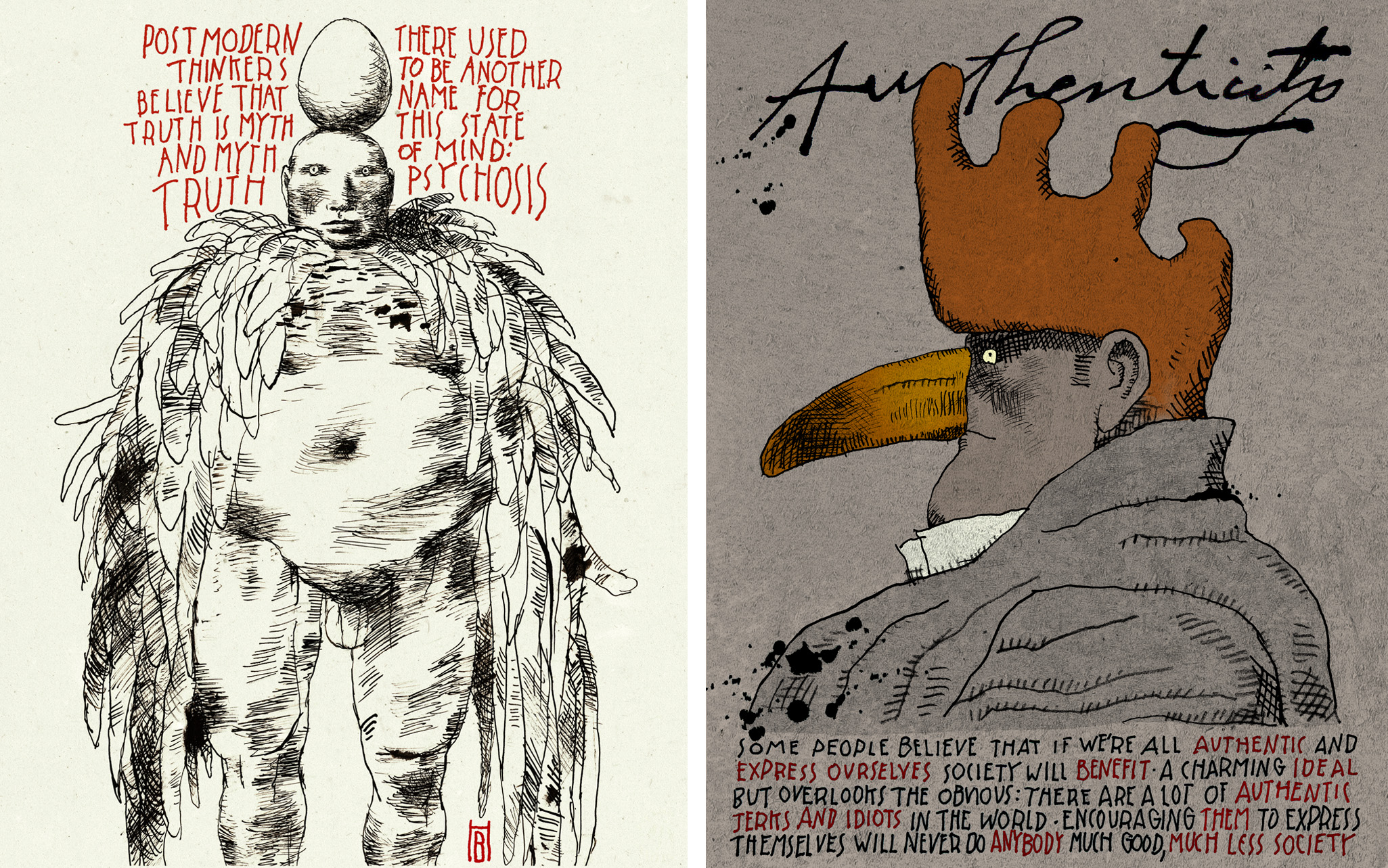
A Different Kind of Mind This was one of a series of posters I did for Chester College last year to promote the school's Creative Writing Department. Anthony Padilla art directed the project. Although I started with a half dozen sketches for each poster, the need to integrate so much text with the art tended to make the final ideas self-selecting. In the end, I submitted only one finished sketch for each design, but I got an OK within minutes and went to work immediately on the final art.


Home is Where You Live Another of the four paintings for Northwestern Magazine, about a homeless man living in a campsite along a river in Sacramento. When the county Parks Department tried to run him off he put his foot down. “Home is where you live,” he said and he refused to budge. 


Global Balance This drawing was for “Japan and the Ancient Art of Shrugging” published on the New York Times Op-Ed page. It was an article about the US and its relationship to the growing dominance of Asia. It was overnight assignment, although the idea was one I’d had around for a while.

Ronald Searle
posted:
As artists, especially when we're young, we find in older artists what we're looking to find in ourselves.
 
If we're good, we take what we need and leave the rest as being too personal to them to be of use to us.
 
When I was young, that person for me was Ronald Searle.
 
It wasn't his style that I wanted. I got over that quickly.
 
It was the witness he bore to the times we lived in.
In his drawings as a Japanese prisoner of war...
In his drawings of the Eichmann trial for Life Magazine...
In his travel drawings for books and for Holiday Magazine...
In his satirical drawings for magazines such as Punch...
In his political drawings...
And in the London character sketches he did for books such as The Big City (1958)...
In pictures like these, he showed the breadth and depth of what art could do and for me, that served as the jumping off point for my own identity as an artist.
 

We all owe a debt to the past. To some people we owe more than to others. I owe a big debt to Ronald Searle, who died over the weekend at 91, almost the same age as my mother.


I never met him and we corresponded only once, some years ago, when I wrote him to say roughly what I've written here. But I never needed more from him than that. With pictures like these he became a part of me many years ago.


These drawings are all Ronald Searle’s, of course, and are protected by his copyrights. 


The New York Times obituary by Steve Heller

Such Stuff As Dreams Are Made On
posted:
Hamlet Act 1 Scene 4

King, father, royal Dane: O, answer me! What may this mean, that thou, dead corse, again in complete steel revisit'st thus the glimpses of the moon, making night hideous; and we fools of nature so horridly to shake our disposition with thoughts beyond the reaches of our souls?

Othello Act 3 Scene 3

Speak to me as to thy thinkings, as thou dost ruminate, and give thy worst of thoughts the worst of words.

A Midsummer Night’s Dream Act 4 Scene 1

My Oberon! what visions have I seen! Methought I was enamoured of an ass.

Julius Caesar Act 2 Scene 1

Between the acting of a dreadful thing and the first motion, all the interim is like a phantasma, or a hideous dream: the genius and the mortal instruments are then in council; and the state of man, like to a little kingdom, suffers then the nature of an insurrection. 

The Merchant of Venice Act 4 Scene 1

The quality of mercy is not strained. It droppeth as the gentle rain from heaven upon the place beneath. . . it is an attribute to God himself, and earthly power doth then show likest God’s when mercy seasons justice.

Romeo and Juliet Act 3 Scene 3

'Tis torture, and not mercy: heaven is here, where Juliet lives; and every cat and dog and little mouse, every unworthy thing, live here in heaven and may look on her; but Romeo may not.

Julius Caesar Act 3 Scene 1

O mighty Caesar! dost thou lie so low? Are all thy conquests, glories, triumphs, spoils, shrunk to this little measure? 

Macbeth Act 2 Scene I

Is this a dagger which I see before me...Come, let me clutch thee. I have thee not, and yet I see thee still.  Art thou not, fatal vision, sensible to feeling as to sight? or art thou but a dagger of the mind, a false creation, proceeding from the heat-oppressed brain? 

Henry V Act 4 Scene 3

This story shall the good man teach his son; and Crispin Crispian shall ne'er go by, from this day to the ending of the world, but we in it shall be remembered – we few, we happy few, we band of brothers; for he to-day that sheds his blood with me shall be my brother; be he ne'er so vile, this day shall gentle his condition; and gentlemen in England now-a-bed shall think themselves accurs'd they were not here, and hold their manhoods cheap whiles any speaks that fought with us upon Saint Crispin's day.

The Merry Wives of Windsor Act 1 Scene 1

It is a familiar beast to man, and signifies love.

King Lear Act 5 Scene 3

The gods are just, and of our pleasant vices make instruments to plague us: the dark and vicious place where thee he got cost him his eyes. Thou hast spoken right, 'tis true; the wheel is come full circle.

The Tempest Act 4 Scene 1

Our revels now are ended. These our actors, as I foretold you, were all spirits, and are melted into air, into thin air: and like the baseless fabric of this vision, the cloud-capp'd tow'rs, the gorgeous palaces, the solemn temples, the great globe itself, yea, all which it inherit, shall dissolve, and, like this insubstantial pageant faded, leave not a rack behind. We are such stuff as dreams are made on; and our little life is rounded with a sleep.

The paintings for Romeo and Juliet, Julius Caesar, Macbeth, King Lear and A Midsummer Night’s Dream were published by Perfection Learning. The others I did to amuse myself. All paintings copyright Brad Holland, 2011. The words, of course, are Shakespeare's.
Recent Articles
Archive

La Ruta De Los Castillos (21)

Poor Bradford's Almanac (7)

RIO By the Sea-O (12)

Hair America (26)

Sketchbooks (61)